
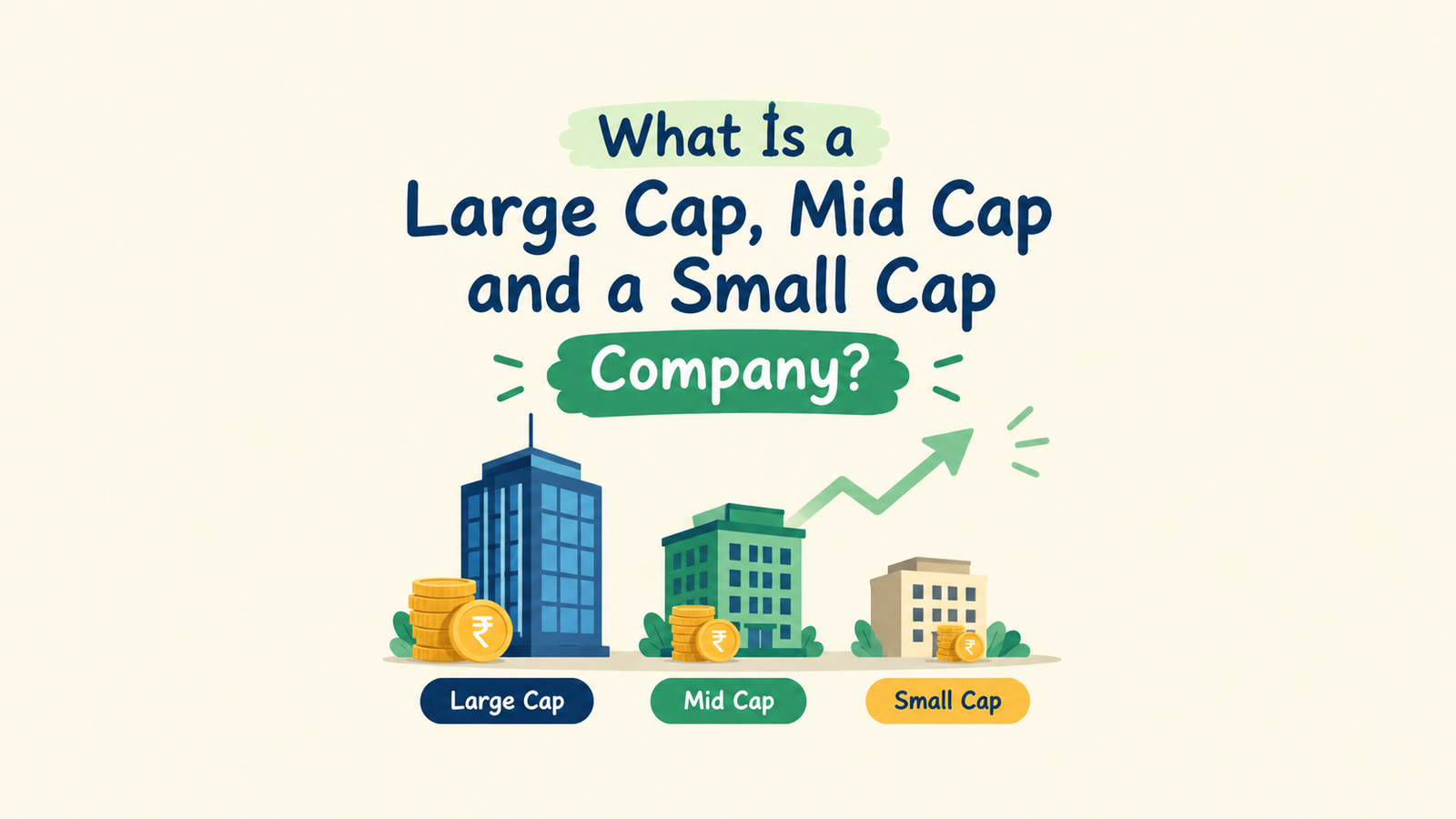
You must have heard…
Airtel is a large cap company…
Trent is a mid-cap company…
I have already explained the meaning of “CAP” in the previous article. Now we will understand what large, mid and small mean here.
What is a large cap company?
SEBI has developed a criteria for classifying large cap companies. The top 100 companies listed in the stock exchange in terms of market capitalisation are classified as large cap companies.
Basically these are relative and keep on changing. Also, known as blue-chip stocks, these are considered safe investments but this is not always true. This has been explained in another article.
What is a mid-cap company?
SEBI established a rule in 2017, according to which companies that are ranked between 101 and 250 in terms of market capitalisation are known as mid-cap companies. Mid-caps are mostly considered fast-growing but a bit less safer than the large – cap companies.
What is a small cap company?
The companies ranked from the 251st position onwards in terms of market capitalization are known as small-cap companies. The market cap lies below 5000 crores for these companies.
They are generally considered risky in terms of investments and do not have a strong track record.
One very interesting point: SEBI sets the rule, but the Association of Mutual Funds in India (AMFI) prepares and updates the official list.
Why is there no Fixed ₹ cutoff?
There is a question that might be coming in your mind:
So, how much market cap does a company need to become large-cap?
Why isn’t there any range mentioned above?
Reason : There isn’t one permanent ₹ amount.
That’s because the classification is based on the company’s ranking compared with other companies by full market capitalization, rather than simply crossing a particular market-cap number.
For example, if a company ranks 95th, it falls within the large-cap category. If another company ranks 101st, it falls into the mid-cap category. It could be possible that the difference in their market caps is very less but the classification is based on ranks.
So, the important question isn’t:
“Is its market cap above ₹X?”
It’s:
“Where does the company rank compared with other companies?”
Can a Company’s Classification Change?
Yes.
Since, the market capitalization changes with the changing market price of the share, its ranking can also change. This implies that the classification will also change with it.
For example, a company that is currently ranked within the top 100 could later fall below the 100th position and move into the mid-cap category.
Similarly, a mid-cap company can move into the large-cap category if its ranking rises sufficiently.
So, large-cap, mid-cap and small-cap are not permanent labels. They are relative terms and depend on the ranking of the companies.
Conclusion
I have summarised everything about these companies in a simple table you can refer to any time.
| Basis | Large Cap | Mid Cap | Small Cap |
| Rank : Classification Basis | 1st-100th | 101st-250th | 251st onwards |
| Risk | Low risk(mostly) | Moderate Risk | High Risk |
| Growth | Steady Growth | Moderate growth potential | High growth potential |
| Liquidity and Volatility | High liquidity and Low volatility | Moderate Liquidity and Moderate Volatility | Low Liquidity and High Volatility |
| Example | Reliance Industries Ltd | Bosch Ltd | Dehlivery Ltd |
And remember, there isn’t a fixed ₹ amount that permanently defines each category.
Now you know how companies are classified – but that brings us to another important question:
Does investing in a large cap company automatically means that your investment is safe?
That’s what we’ll understand in the next article.
Thanks for reading till the end – Isha Singla(About)
Related Articles
What Is a Dividend? Meaning, Calculation, and Important Dates
What Is a Bonus Share? How It Works, Bonus Ratios & Why Companies Issue Them
Leave a Reply