
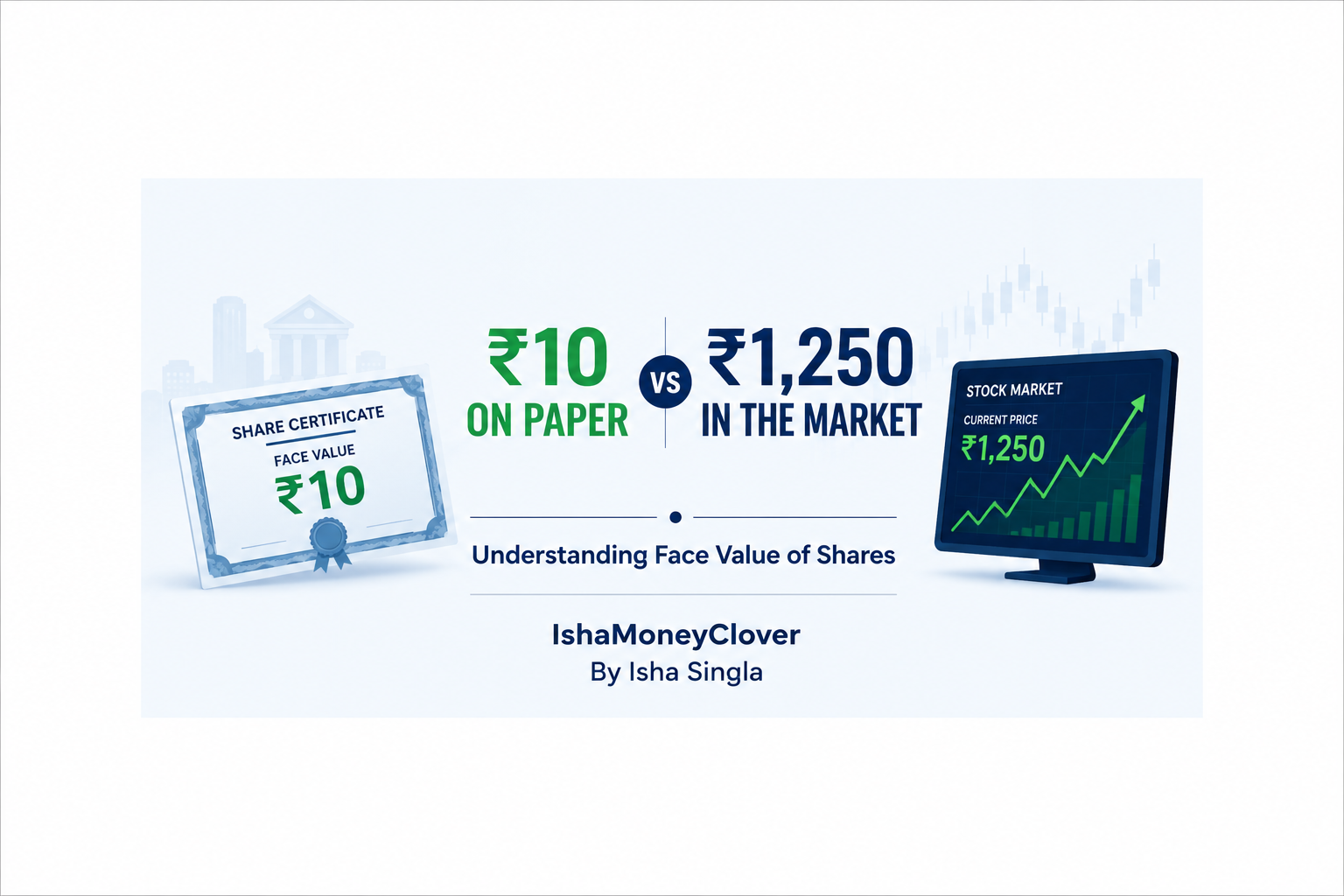
Whenever you open up your trading app. You see only one value- the current share price.
And to be honest, most of the time this is the value you should care about.
But, face value is another value that the investor should understand.
What is the Face value of a share?
Face value is the base price assigned by a company to its shares when they are issued, such as during an IPO(Initial Public Offering).
It is written in their accounting records and does not change with the market movements.
It is usually nominal- ₹ 1,₹2,₹5, or ₹10. It is printed on the share certificate and serves as a reference for the accounting records of the company.
Is it the price at which you buy a share in the market?
Absolutely NO.
The buying and selling of shares is done at the Market value of a share.
Face Value vs Market Value: What’s the Difference?
| BASIS | FACE VALUE | MARKET VALUE |
| Definition | Fixed by the company when the shares are issued. | The value at which shares are traded on the stock exchange. |
| Changes over time | Remains unchanged usually but can change during stock splits or consolidation. | Change continuously depending on the demand and supply |
| Purpose | Used for accounting purpose,dividends, stock splits, etc | Used by every investor whenever he or she trades in the market. |
| Example(Reliance Industries Limited) | ₹10 | ₹1291 |
If you want to know why share prices move up and down everyday- Read Here.
Why Should Investors Care About Face Value?
They are not used during trading. So why do investors care about it?
- Dividends
Any company announces a dividend on the face value, not the market value of share.
If a company says that it is giving 100% dividend, it means:
| Dividend = Number of shares * Face value of a share. |
Example:
Aryan has 200 shares of Reliance Industries Limited. Reliance announced a 50% dividend.
| Face value of a share : ₹ 10 Market value of a share: ₹ 1291 Number of shares : 100 Dividend = (10*50%) * 100 = ₹ 500 |
This ensures dividends are predictable and easily accountable over long periods of time and are independent of the market volatility.
- Stock Split
A Stock split happens when a company divides its existing shares into multiple shares to push up the trading activity.
The catch is that the total market value of the company remains the same. Along with this, the total accounting equity remains completely unchanged.
Individual allotments change accordingly to make sure this happens.
What changes for the investors?
- Face value of a share
- Market value of a share
- Number of shares held by the investor
For example Aryan held 500 shares of a company A that announced a stock split of 1:2.
It means for every 1 share he gets 2 shares.
So the number of shares become 500*2=1000
But, the face value and the market value of the share get halved that is multiplied by ½.
| Here: Face value of the share is ₹ 10. Market value of the share is ₹ 2000 |
| Now the values will be: Face value: ₹ 5 Market value : ₹ 2000 |
This ensures that the overall value of the shares or even the company’s market value of shares remain constant.
3. Share consolidation
This is exactly the opposite of stock split. Here the company combines the shares. Here too, the market value of the company remains the same.This means that the face value of the shares increase and there is a decrease in the number of shares.
So, now if company A announces a share consolidation of 2:1. This means 2 shares are combined into 1. Then the number of shares will decrease once again.
| Number of shares = 1000 / 2 = 500 Face value= ₹5 * 2 = ₹10 Market value= ₹1000 * 2 = ₹2000 |
It is done to boost the share price. This could be helpful in meeting the stock exchange requirements or show that the share is stable.
Conclusion
So, as an investor, face value might not be the most visible concept. But, it helps investors to know more about investment returns, dividends and in general understanding what is happening in the market.
Thank you for reading till the end- Isha Singla(About)
If you want to understand an amazing psychological aspect of the market- Why investors panic sell – Read Here
Leave a Reply