
You invest in a share. You gain ownership. But shares are considered risky. Your returns depend on how well the share performs in the market. There is a risk that the share price could fall.
Is there something the company gives you in return?
Yes, a dividend.
Understanding Dividend
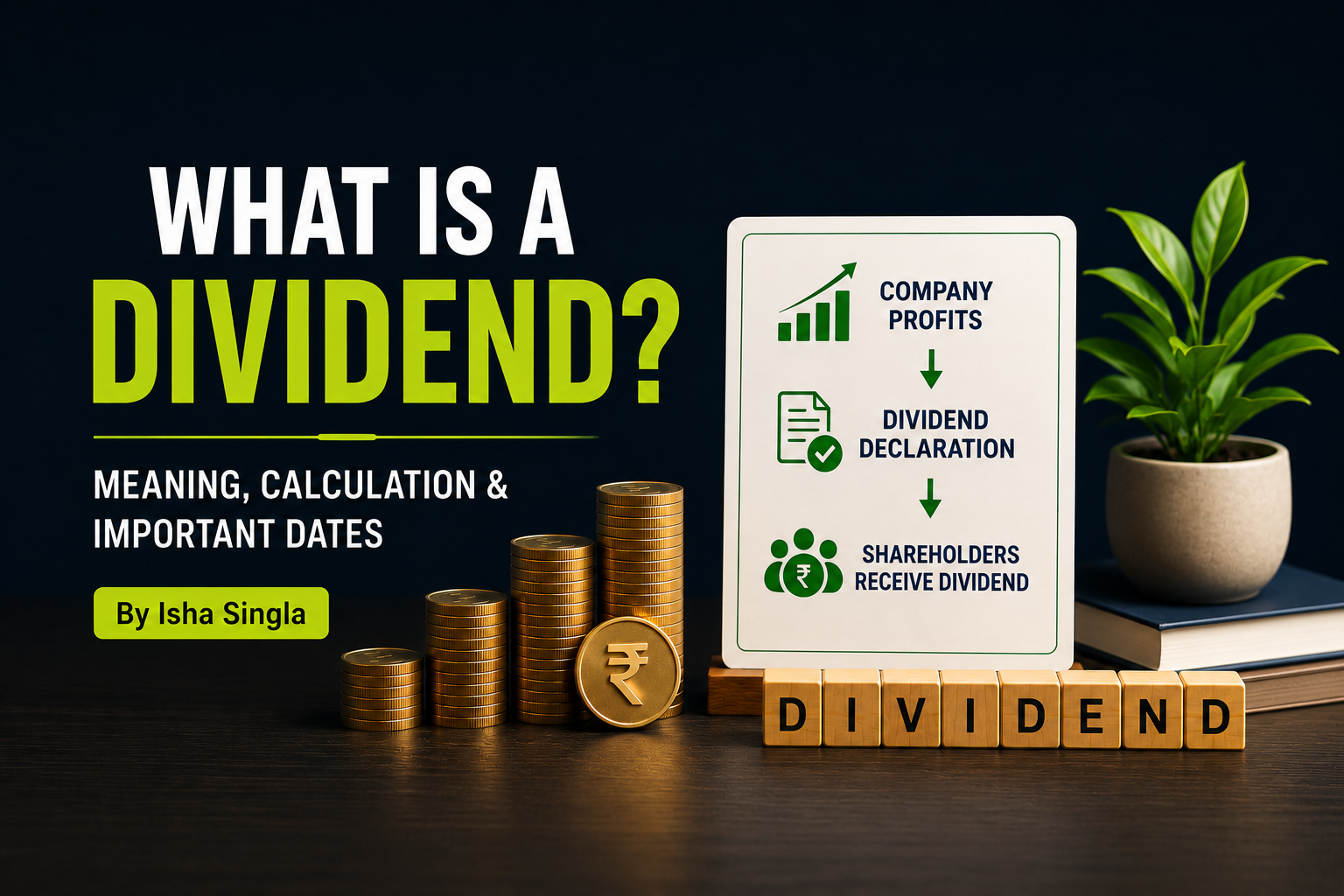
A dividend is the share of the company’s profit given to the shareholders, usually as a reward for their investment. They could be paid quarterly or even annually, or can be a one-time dividend payout. They act as a source of income to the investors apart from the share value.
Distribution:
Since it is part of the company’s profit, when the company is profitable, the board of directors decide how much of the company’s earnings are to be retained and how much is to be given as dividends to the shareholders.
Calculation:
Dividend is given on the face value of the share and not the market value.
Example:
| Company A: Face Value: ₹10 Market Value: ₹1250 Dividend announced: 50% |
| Dividend Per Share(DPS): |
Then:
| Dividend Per Share = (50 * Face value)/100 = (50 * ₹ 10)/100 = ₹ 5 |
So, if Aryan had 200 shares, then the dividend is:
| Dividend = Number of shares * Dividend per share = 200 * ₹5 = ₹1000 |
So, what an investor needs to remember is: The dividend will not change with the fluctuation in the share prices.
Is the company liable to pay it?
No.
Companies are under no legal liability to pay dividends to their common shareholders. The decision to pay is voluntary in nature and is at the discretion of the board of directors depending on their discretion. Sometimes the companies decide to:
- Reinvest: Many growing companies reinvest their profits rather than giving out dividends. For example: Apple is a company known for reinvestment.
- Maturity: Mature companies, which are stable companies that have fewer high-return opportunities, give regular dividends.
- Discretion: Companies can decide not to, delay or even eliminate payouts in times of financial difficulties.
Important Dates:
This is very important for an investor. To receive the dividend, the investor needs to take care of this:
- Declaration Date: The company announces the dividend with all the important dates, that is, the ex-dividend date, record date and payment date.
- Ex-dividend date: This is the most crucial. The investor must hold the shares in his or her account before this date to be eligible for the dividend. There are settlement cycles like the T+1 and T+2 cycles, meaning it takes 1 day and 2 days, respectively, for the shares to be deposited in the individual’s account. If the investor holds the share on or after this date, the previous owner gets the dividend.
- Record Date: It is the date the company checks its records to determine officially who is eligible to receive the payment. Usually, the ex-dividend date is one day before the record date.
- Payment date: It is the date the payouts are deposited in the shareholder’s account.
Conclusion
Dividends are a reward to the shareholders. They can be a regular source of income and also even an indicator of a stable company. They are also considered an important indicator by some investors when they purchase the shares of a company.
Learning these concepts can help you assess whether a particular company stock aligns with your financial goal.
Thanks for reading till the end – Isha Singla(About)
Leave a Reply