
Raman had ₹100000 that he wanted to invest in the share market. He wanted to buy shares of company A. He saw the financials and realised the company was financially strong. But, he forgot one thing.
Market Price of 1 share of company A was ₹10000. He felt that he would be able to buy only 10 shares of only one company.
It will become a big risk for him.
So, he abandoned it and chose other shares to diversify the risk.
I have only taken one example. But, there are many. A very high price of a share limits the investor’s capability to buy it along with concentration of the risk.
But, here comes stock split into picture.
Understanding a stock split?
A Stock split happens when the company divides its existing shares into multiple new shares.
Does the market cap of the company change?
No, because the price per share drops proportionally. This ensures that the total market value of the company does not change.
Solution to Raman’s Problem:
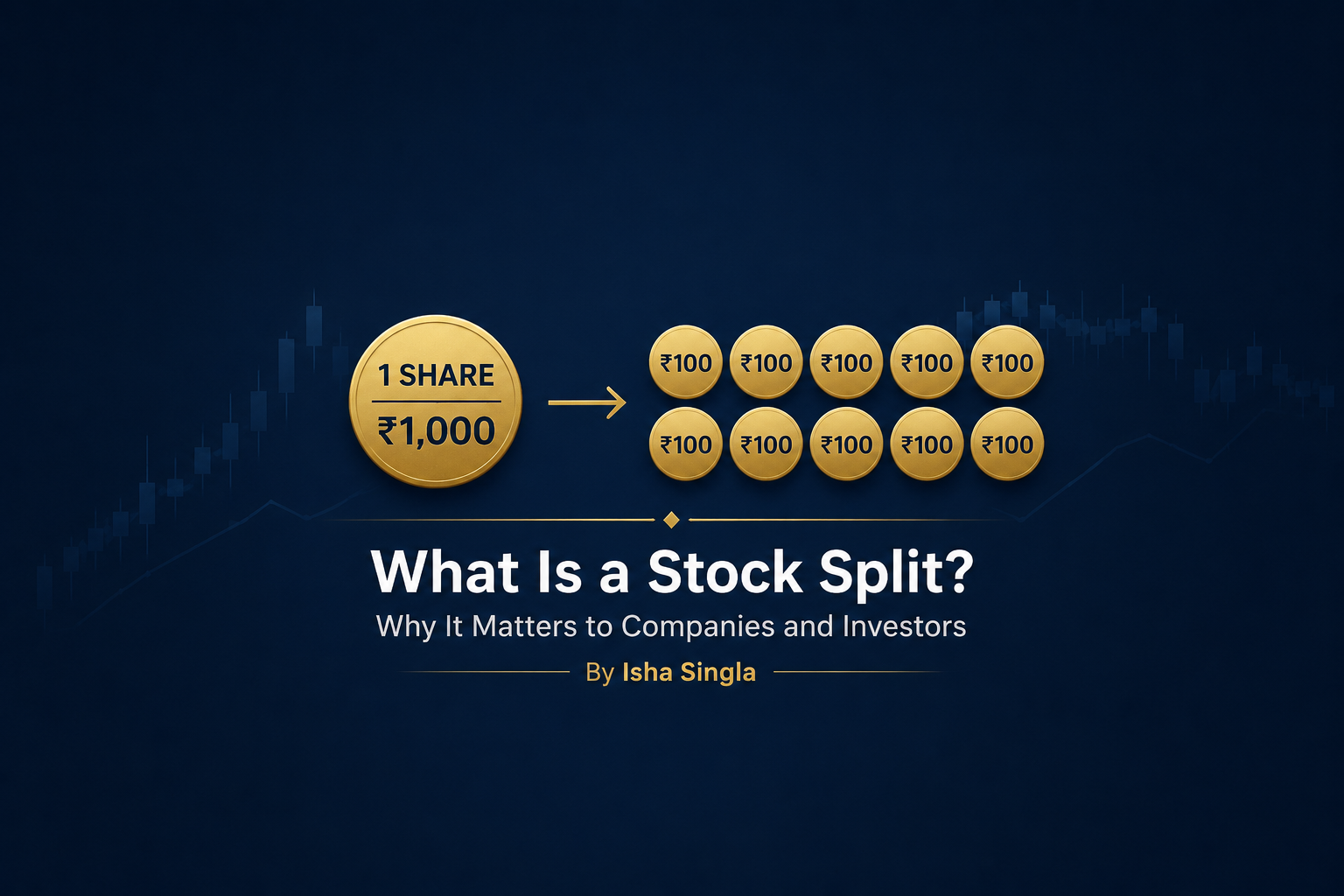
The company A announced a stock split of 1:10.
Price of the share: ₹10000
Stock Split Ratio : 1:10
This means that for every one share an investor gets 10 shares.
And the price of the share reduces by 1/10
Market Price of the share after stock split
= 10000/10 =₹1000
Now, with a corpus of ₹10000, he can use a percentage say 50% for buying the shares of company A.
Thus, he buys 50 shares of company A and use the remaining to buy other stocks that can diversify his risk.
What does an investor gain from it?
- Increase in Affordability:
Stock Split makes the share more affordable in the market. This makes it affordable to the small investors with limited capital.
- Diversification of risk:
When the share price is high, then the investor might have to allocate a large portion of its capital to buy a few shares of a company. When a stock split happens, then the investor can now diversify his or her risk by buying shares from multiple companies.
- Increase liquidity for the investors:
Stock split increases the number of shares in the market, despite the market cap being the same. But with the increase in the number of shares, the buying and selling of the shares also increases, which improves the liquidity of the shares.
- Psychological comfort:
Many investors feel it is psychologically easier to buy a share at Rs 1000 rather than buying a share at Rs 10,000. A stock split can make the share appear more accessible.
- Benefits to the those who were already investors:
With the increased liquidity, the share price sometimes rises after a stock split. This is a direct benefit to those investors who had already invested in this stock for a long time.
But, investors should not forget that a stock split does not mean a change in the intrinsic value of the company. The market cap and his own capital remains the same. It is just that the number of shares increases.
What does the company gain from it?
A stock split does not increase a company’s profits, assets or intrinsic value. But, it offers the following benefits.
- Greater Accessibility for the Investors:
Raman was able to access the share of Company A after its stock split. Similarly, a stock split improves affordability of the stock.
- Improved Liquidity:
After the stock split, the number of shares in the market increase. This results in the increase in the buying and selling of shares. This actually might leads to the rise in the Market Price of the share.
- Broaden Shareholder Base:
Since the share becomes cheaper, it can attract new investors who might have thought it to be expensive earlier. This widens the shareholder base of the company.
- Positive Market Signal:
Stock splits are announced usually when the company sees an increase in the share price. So a stock split is a signal that the management is confident in the company’s futures prospects.
- Better Trading Flexibility:
Stock split can make the trading easier for these smaller investors since they can buy the stocks in smaller quantities at lower share prices. This offers better trading flexibility in the market.
Conclusion
Stock split is similar to when you exchange one ₹500 note for five ₹100 notes. The number of notes changes, but the total value remains the same. It benefits both the investors and the companies in some ways but it should not be viewed as a value-creating event in itself. It should be rather seen as a mechanism that makes the stock more accessible and easier to trade.
Thanks for reading till the end – Isha Singla(About)
Leave a Reply